

Table of Contents
Introduction
Jungle Trail Noida is a 20-acre eco park that offers a different kind of outdoor experience within the city. As you enter the space, you begin to notice animal sculptures made form scrap placed along the walking paths, creating a setting that feels open, calm, and easy to explore at your own pace. The layout is straightforward, yet it naturally draws your attention as you move through the trail.
What do you expect when you first see these animal figures from a distance? Most visitors would assume they are regular installations. However, as you get closer, the details start to stand out. The surfaces are not uniform, the edges are visible, and the structure behind each sculpture becomes clearer. It’s here that you realize these are not conventional creations but carefully assembled forms made from reused industrial scrap.
Walking through Jungle Trail Noida, the experience feels less about spectacle and more about observation. You notice how materials are reused, how structures are formed, and how each piece contributes to the overall environment. It’s not overwhelming, but it does encourage you to slow down and look more closely at what surrounds you.
How Waste Is Turned into Art in Eco Parks
A waste-to-art eco park is a space where discarded or unused materials are transformed into sculptures, structures, and installations instead of being sent to landfills. The idea is to reduce waste by giving it a second life, turning industrial scrap into something visually meaningful and environmentally responsible. It combines sustainability with creativity, showing how materials that are no longer useful in their original form can still be repurposed in practical and artistic ways.
In Jungle Trail Noida, this concept is applied on a much larger scale. Here, industrial scrap is not just used for a few installations; over 500 tonnes of industrial scrap have been repurposed to create more than 800 animal sculptures across the park. This approach highlights how waste management, design, and public spaces can come together to create something that is both functional and engaging for visitors.

What makes Jungle Trail different?
Jungle Trail does not rely on greenery alone to hold attention.
The park is designed as a walk-through space where sculptures and layout work together. As you move from one section to another, the placement feels deliberate. There is enough space to observe each structure without feeling crowded.
A few things stand out during a visit:
- The sculptures are large enough to feel present in the environment
- The materials are visible, but not distracting
- The layout guides movement without needing clear directions
It feels less like a display and more like a space that has been planned as a whole.
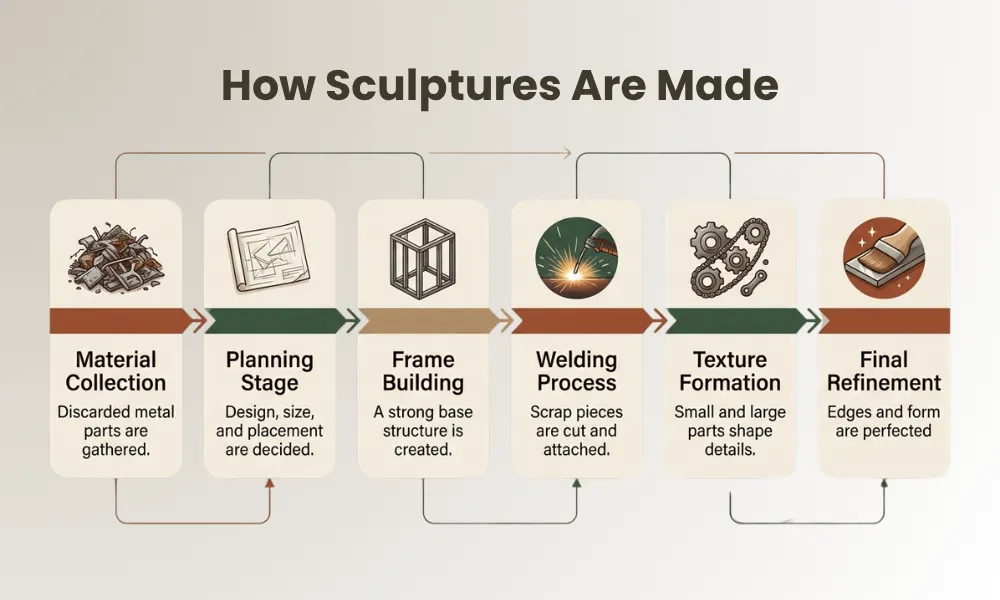
How are Sculptures at Jungle Trail Noida made?
The sculptures at Jungle Trail Noida are created by repurposing large quantities of industrial scrap, including metal sheets, pipes, chains, gears, nuts, bolts, and rods, which are otherwise considered waste. Instead of discarding these materials, they are collected, sorted, and brought into workshops where the transformation process begins.
The first stage involves planning. The design team decides what needs to be created, the approximate size of each sculpture, and its placement within the park. This ensures that every installation fits naturally into the overall layout and maintains visual consistency across the space.
Once the planning is complete, a strong metal frame is built to act as the base structure or skeleton of the sculpture. Scrap materials are then cut, shaped, and welded onto this frame. Gradually, the structure takes form as different components are assembled into recognizable animal figures. Smaller pieces are used to create texture, while larger sheets define the main body, and elements like chains or rods are incorporated in a way that complements the overall design.
In the final stage, the sculpture is refined by adjusting edges, aligning surfaces, and fine-tuning details so that the finished piece appears cohesive rather than assembled from separate parts. This step ensures that each installation looks complete and visually balanced.
This approach is what defines Jungle Trail Noida, where over 500 tonnes of industrial scrap have been transformed into hundreds of animal sculptures, combining sustainability with large-scale creative design.
What Visitors Don’t Usually Notice at Jungle Trail
At first glance, many visitors are drawn to the size of the sculptures. However, the real detail becomes noticeable only when you slow down and observe closely. The surfaces are built using layered scrap materials, which give each structure a textured and slightly industrial character. This effect is not always visible from a distance but becomes clear upon closer inspection.
Lighting also plays a role in how these sculptures are perceived. As natural light changes throughout the day, shadows shift across the surfaces, highlighting different elements of the same structure. This subtle variation adds depth to the experience without drawing immediate attention.

What Makes These Animal Sculptures Feel So Real in this Eco Park?
The layout of the park contributes significantly to the overall experience. The sculptures are placed with enough space between them, allowing visitors to move comfortably and observe each installation without feeling rushed. The scale of the figures adds to their presence, while the themed arrangement helps create a sense of continuity across the space.
Because of this thoughtful placement, the park does not feel like a random collection of installations. Instead, it feels like a connected environment where each element has been positioned with intention, creating a smooth and coherent experience for visitors.
Why are Waste-to-Art Parks growing in India
Waste-to-art parks reflect a growing shift in how urban spaces are being designed in India. With increasing industrial and municipal waste, there is a parallel need to find sustainable ways of managing and repurposing materials. At the same time, cities are looking for public spaces that offer more than just basic recreation.
These parks address both needs by converting waste into functional and visual installations. They also serve as informal learning spaces, where sustainability is demonstrated through real examples rather than explained in theory. This practical approach makes the concept easier to understand and more engaging for visitors of all ages.
What to expect when you visit
Jungle Trail is best experienced at a relaxed pace. It is well-suited for visitors who enjoy walking, exploring open spaces, or spending time with family. The environment is open and spread out, allowing you to take your time as you move from one section to another.
If you are planning a visit, it is helpful to go during the morning or evening hours when the weather is more comfortable. The park is often considered a good option for family outings and educational visits, especially for children who can observe the sculptures up close and understand how everyday materials can be reused in creative ways.
Frequently Asked Questions
1. Is Jungle Trail Noida made entirely from waste materials?
Most of the sculptures and installations are created using recycled industrial scrap such as metal sheets, pipes, chains, and mechanical parts. These materials are repurposed and transformed into animal sculptures rather than being discarded.
2. How long does it take to explore Jungle Trail Noida?
On average, visitors spend around 1.5 to 2 hours exploring the park at a comfortable pace, depending on how much time they take to observe the sculptures and walk through the different sections.
3. Is Jungle Trail Noida suitable for children?
Yes, the park is family-friendly and works well for children. It offers an open environment where kids can see large animal sculptures up close while also learning about reuse and sustainability in a simple, visual way.
4. What makes Jungle Trail Noida different from a regular park?
Unlike a typical park, Jungle Trail focuses on large-scale animal sculptures made from industrial scrap. The combination of art, reuse of materials, and structured layout creates an experience that blends recreation with sustainability.
Final thoughts
Jungle Trail Noida is built on a simple idea, but its execution is what makes it stand out. The sculptures are not just visual installations; they represent a process of reuse, planning, and design that transforms discarded materials into something purposeful.
As you spend more time there, your perspective gradually changes. What initially appears to be a themed outdoor space begins to reveal layers of detail, structure, and intention. That shift in understanding is what makes the experience more meaningful than it seems at first glance.