
Table of Contents
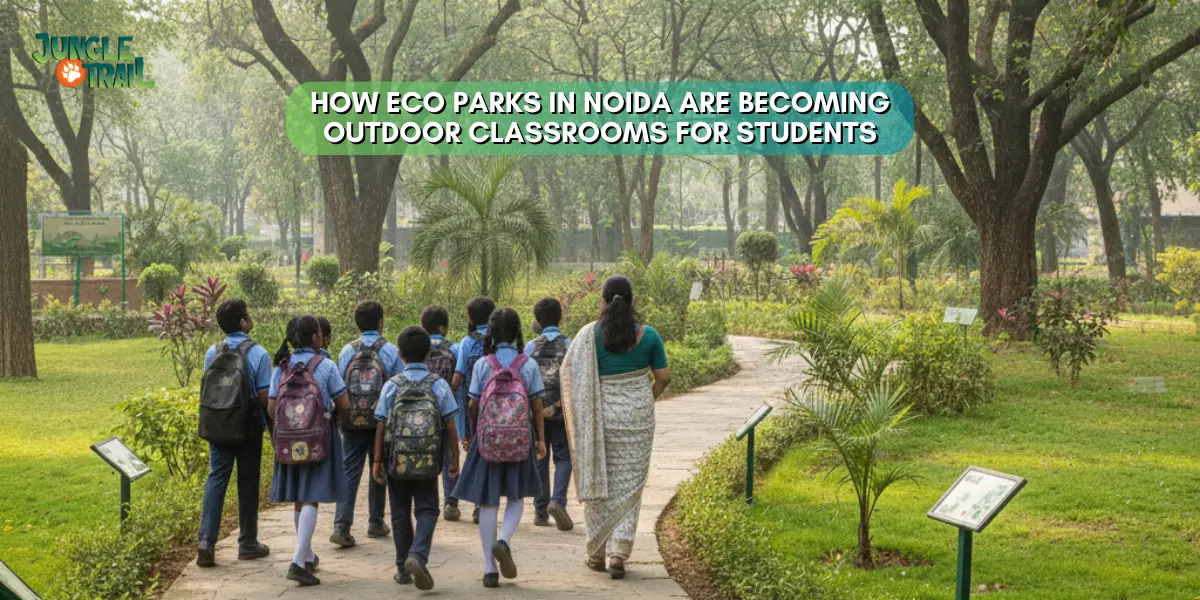
Education in urban India is undergoing a quiet but meaningful shift. As cities expand and classroom learning becomes increasingly screen-driven, educators and parents are looking for ways to reconnect students with the real world. In this transition, eco parks in Noida are emerging as powerful outdoor classrooms, offering students learning experiences rooted in observation, interaction, and environmental context rather than memorization alone.
These parks are redefining how environmental education, sustainability, and experiential learning are delivered in dense urban settings where access to nature is limited.
Why Students Learn Better Outside the Classroom?
Traditional classrooms are effective for structured instruction, but they often struggle to bring abstract concepts to life. Subjects like environmental studies, geography, and biodiversity require context, scale, and real-world reference points, something that textbooks alone cannot fully provide.
Outdoor learning environments allow students to:
- Observe natural systems instead of imagining them
- Understand cause-and-effect relationships visually
- Engage multiple senses, improving memory and comprehension
Research consistently shows that learning through direct experience improves retention, curiosity, and critical thinking, especially among younger students.
What Is an Outdoor Classroom?
An outdoor classroom is a structured learning environment located outside traditional school buildings, designed to support educational objectives through interaction with physical surroundings.
Unlike free play or casual outings, outdoor classrooms are intentional. They rely on:
- Observation-based learning
- Guided exploration
- Discussion and reflection
- Real-world examples tied to curriculum concepts
Eco parks naturally function as outdoor classrooms because they combine open space, environmental design, and interpretive elements in one setting.
Why Eco Parks Work as Educational Spaces?
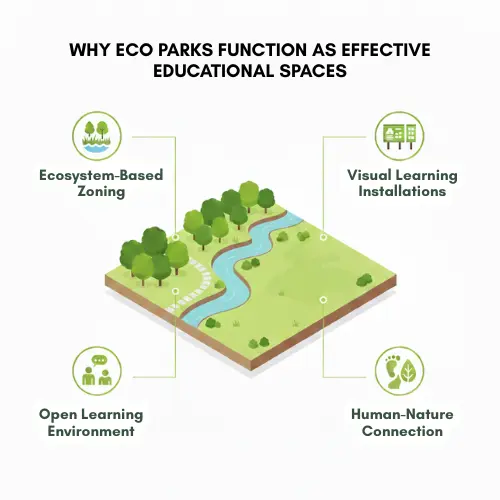
Eco parks are not designed solely for recreation. Their layouts, themes, and materials are often centered on environmental awareness and sustainability, making them uniquely suited for learning.
Key characteristics that support education include:
- Ecosystem-based zoning that explains biodiversity
- Visual installations that simplify complex ideas
- Open environments that encourage inquiry and discussion
- Design elements that connect human activity with environmental impact
For students, this transforms learning from theoretical knowledge into contextual understanding.
The Urban Advantage: Eco Parks in Noida
In cities like Noida, rapid urbanization has reduced everyday exposure to natural environments. Eco parks help address this gap by embedding learning opportunities within the city itself.
Noida’s eco parks:
- Provide accessible green learning spaces for schools
- Introduce sustainability concepts within an urban context
- Offer environments where students can understand how cities and nature coexis
This urban relevance makes learning more relatable and meaningful for students growing up in metropolitan regions.
Jungle Trail Park as a Learning Environment
Jungle Trail Park in Sector 94, Noida, offers a clear example of how eco parks can function as outdoor classrooms at scale. Developed as a waste-to-wonder initiative through a Public-Private Partnership between the Noida Authority and Z-Tech, the park integrates sustainability, public art, and environmental education across a 20-acre landscape.
The park repurposes over 500 tonnes of industrial and automotive scrap into more than 800 life-sized wildlife sculptures, representing ecosystems from forests and wetlands to deserts and polar regions. This design approach turns waste management into a visible, tangible learning model.
From an educational standpoint, Jungle Trail supports learning by:
- Demonstrating upcycling and circular economy principles visually
- Using ecosystem-based zoning to explain biodiversity and habitats
- Allowing students to compare species, climates, and environments spatially
- Encouraging observation-led discussion rather than passive instruction
Rather than explaining sustainability as a concept, the park allows students to see and interpret it directly.
How Learning Happens Inside Eco Parks?
Eco parks become effective outdoor classrooms when learning is structured around exploration and reflection.
Guided Exploration
Students move through themed zones while educators encourage observation, questioning, and discussion.
Sustainability Demonstrations
Recycled materials, installations, and infrastructure help students understand waste reduction and reuse in real-world contexts.
Observation and Documentation
Students sketch, note, or photograph elements, reinforcing attention to detail and analytical thinking.
Group Reflection
Open spaces allow educators to connect observations back to classroom lessons through discussion and activities.
These methods shift students from passive listening to active participation.
Age-Wise Learning Outcomes for Students
Eco parks support different learning outcomes depending on age group:
Primary Students
- Recognition of animals, plants, and habitats
- Curiosity about nature
- Early understanding of care for the environment
Middle School Students
- Introduction to ecosystems and biodiversity
- Understanding human impact on nature
- Observation-based reasoning and comparison
Senior Students
- Sustainability and conservation concepts
- Waste management and upcycling systems
- Critical thinking about urban development and ecology
This flexibility makes eco parks relevant across grade levels.
Educational Value for Schools and Educators
For schools, eco parks provide more than a field trip destination. They support:
- Curriculum-aligned experiential learning
- Environmental education objectives
- Interdisciplinary learning across science, geography, and art
- Long-term student engagement beyond the visit
Educators often find that outdoor learning experiences make classroom discussions more grounded and participatory afterward.
Why Learning in Eco Parks Stays With Students?
What students experience visually and physically is easier to recall than what they read or hear. Eco parks provide:
- Strong visual anchors for abstract concepts
- Emotional engagement through scale and immersion
- Contextual understanding that improves long-term memory
These experiences often continue to influence how students think about sustainability and the environment long after the visit.
The Role of Eco Parks in the Future of Urban Education
As cities continue to grow, education models must adapt to limited space and increasing environmental challenges. Eco parks offer a scalable solution by integrating learning into urban public spaces.
In cities like Noida, eco parks:
- Complement formal education systems
- Provide accessible outdoor learning environments
- Support sustainability-focused education for future generations
They represent a shift toward learning that is contextual, experiential, and connected to real-world challenges.
Frequently Asked Questions
1. What is an outdoor classroom?
An outdoor classroom is a learning environment outside traditional classrooms where students learn through direct interaction with nature and physical surroundings.
2. How do eco parks support student learning?
Eco parks enable observation-based, experiential learning that helps students understand environmental concepts more clearly and retain them longer.
3. Why are eco parks important in urban education?
Eco parks provide essential exposure to nature in urban areas, helping students connect classroom knowledge with real-world environmental systems.
Conclusion
Eco parks in Noida are reshaping student learning by transforming green spaces into functional outdoor classrooms. Through experiential design, sustainability-focused environments, and real-world learning models—such as those demonstrated at Jungle Trail Park—these spaces help students understand environmental concepts in a deeper and more lasting way. As education continues to evolve, eco parks will play an increasingly important role in creating informed, aware, and environmentally responsible learners.
👉 Don’t wait, bring students to Jungle Trail Park and let them experience learning like never before!

Leave a Reply